Book Ganesh Puja Online or At Home with Verified Vedic Pandits | Naman Puja
Ganesh Puja is one of the most important Hindu rituals performed to seek the blessings of Lord Ganesha, the remover of obstacles and the deity of wisdom, success, and new beginnings. Book an authentic Ganesh Puja online or at home with verified Vedic Pandits through Naman Puja, complete with traditional vidhi, samagri, and live Sankalp.
Ganesh Puja isn't tucked away for a single festival day. It's the puja people reach for at the start of things -a new house, a new business, an exam, a wedding date, even a car that's about to leave the showroom. Lord Ganesha, son of Shiva and Parvati, carries the title Vighnaharta for a reason: he's worshipped as the one who clears the obstacle before it becomes a problem, not after. That's why his idol sits at the doorway of so many rituals, quite literally -most other poojas open by invoking him first.
Here's where it usually gets complicated, though. A proper Ganesh Puja needs an experienced pandit who knows the Shodashopachara sequence, the right samagri down to the durva grass count, and the discipline to get the sankalp and mantras right -and coordinating all of that from scratch, especially in a new city or a packed week, eats up time most people don't have. Naman Puja handles that coordination end to end, whether you'd rather have a verified pandit arrive at your home with everything in hand, or join a live, guided Ganesh Puja online from wherever you are.
Benefits
| Benefit | What It's Traditionally Sought For |
|---|
| Obstacle removal | Clearing hurdles standing in the way of a new venture, home, or milestone |
| Wisdom & clarity | Blessing of clear judgment before major decisions |
| Prosperity & good fortune | Commonly performed before business launches and ahead of Lakshmi Puja on Diwali |
| Auspicious beginnings | Inviting a settled, positive start to a new home or workspace |
| Sustained devotion | Regular Chaturthi observance as an ongoing spiritual practice, not a one-time request |
| (These are traditional beliefs associated with the ritual, not guaranteed outcomes.) | |
What Is Ganesh Puja?
Ganesh Puja is the worship of Lord Ganesha -the elephant-headed son of Shiva and Parvati, revered as the remover of obstacles and the god invoked at the start of nearly every undertaking, sacred or otherwise. Families perform it before laying a foundation, moving into a new home, launching a business, or simply on a Chaturthi as an act of routine devotion. It doesn't demand priestly training or a lifetime of ritual knowledge on the part of the household -the pandit carries that weight -which is part of why it's one of the most widely performed poojas across Indian households, online and offline alike.
How the Pooja Is Performed
Ganesh Puja follows the broader Shodashopachara (sixteen-step) tradition of Ganapati worship, drawing on invocations found in texts such as the Ganesh Atharvashirsha.
| Step | What Happens |
|---|
| Sankalp | The host states name, gotra and intent aloud, formally beginning the puja and dedicating it to a specific purpose |
| Kalash Sthapana | A kalash is set up and consecrated, representing the presence of divine energy through the ritual |
| Ganesh Sthapana & Pran Pratishtha | The Ganesha idol is placed and ritually invoked -life-breath is symbolically infused into the murti |
| Panchamrit Abhishek | The idol is bathed in panchamrit (milk, curd, ghee, honey, sugar), followed by Gangajal |
| Shodashopachara Puja | The sixteen traditional offerings -vastra, chandan, akshat, flowers, incense, lamp and more -are made in sequence |
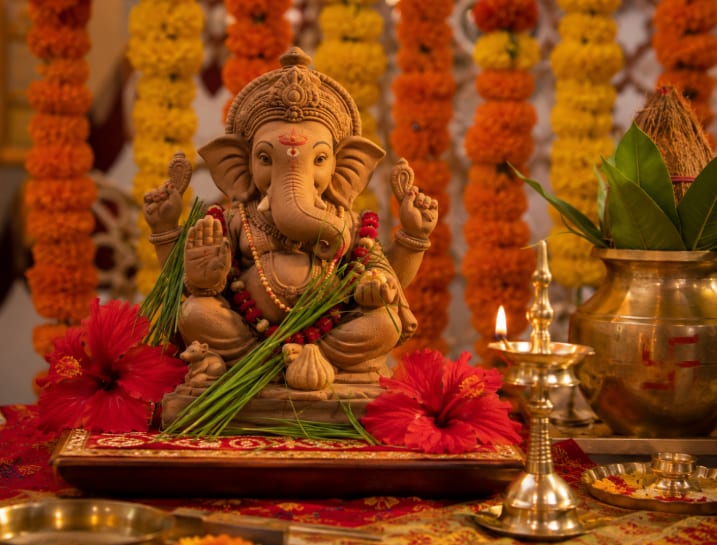
| Durva & Flower Offering | Twenty-one blades of durva grass and red hibiscus are offered, both considered especially dear to Ganesha |
| Modak/Naivedya Offering | Modak, laddoo and fruits are offered as bhog |
| Ganesh Havan (where included) | A short havan is performed invoking Ganapati mantras over the sacred fire |
| Aarti | The Ganesh Aarti is sung, closing the main worship |
| Visarjan (Ganesh Chaturthi only) | For Ganesh Chaturthi specifically, the idol is ceremonially immersed at the end of the observance period |
| A standard Ganesh Puja at home is typically completed within 1 to 2 hours; adding a havan extends this somewhat. | |
Samagri Included
Ganesh idol (clay/traditional)
Kalash
Coconut
Mango leaves
Betel leaves and betel nuts
Durva grass (21 blades)
Red hibiscus and marigold flowers
Kumkum, turmeric (haldi), sandalwood paste (chandan)
Akshat (rice)
Incense sticks and camphor
Ghee lamp with cotton wicks
Panchamrit and Gangajal
Fruits, banana, sugarcane
Modak, motichoor laddoo, dry fruits, sweets
Garland and sacred thread (mouli)
Online Pooja vs. At-Home Pooja
| Online Ganesh Puja | At-Home Ganesh Puja |
|---|
| Where it happens | Live video session, pandit guides you through each step | Pandit performs the puja in person at your residence |
| Your role | You perform the actions yourself, following the pandit's live instruction | You can participate directly, or largely observe while the pandit conducts it |
| Samagri | A samagri kit is shipped to your address ahead of the session | Pandit brings the full samagri, nothing to arrange yourself |
| Prasad | Prepared at your end following guided instructions, or a prasad box included with the kit | Prepared and offered on-site by the pandit |
| Best for | NRIs, those in cities without easy access to a pandit, or anyone wanting flexible timing | Those who want the pandit physically present, larger family gatherings, or a full havan setup |
Why Book With Naman Puja
| Verified, experienced pandits -every pandit performing your Ganesh Puja is vetted for Vedic training and puja experience, not just availability |
|---|
| Prasad handled properly -modak and other naivedya are either prepared on-site or delivered, depending on the format you choose |
| Transparent, upfront pricing -you know the full cost before you confirm, no surprise add-ons on puja day |
| Authentic samagri, sourced correctly -durva grass, red hibiscus, modak and the rest arrive fresh and complete; no last-minute run to three different shops |
| Your choice of format -book an at-home Ganesh Puja with the pandit visiting you, or a live online Ganesh Puja guided over video |
| Support before and after -from picking the right tithi to understanding what each step of the vidhi means, there's someone to ask |
Benefits
| Traditionally believed to clear obstacles standing in the way of a new venture, home, or milestone |
|---|
| Many families perform this puja seeking Ganesha's blessing of wisdom and clear judgment before major decisions |
| Associated in tradition with prosperity and good fortune -hence its place before business launches and Diwali's Lakshmi Puja |
| Often performed to invite an auspicious, settled start to a new home or workspace |
| Regular Chaturthi observance is, for many households, simply a sustained practice of devotion rather than a one-time request |
Who Should Book This Pooja
| Moving into a new home or performing Griha Pravesh |
|---|
| Before Bhoomi Poojan or breaking ground on construction |
| Opening a new office, shop, or business |
| Buying a new vehicle |
| Before an exam, interview, or a major decision |
| On Ganesh Chaturthi, Sankashti Chaturthi, or Angarki Chaturthi as festival observance |
| Before other poojas and ceremonies, where Ganesha is customarily invoked first |
Best Days to Perform It
| Chaturthi -the fourth day of each lunar fortnight -is the tithi most closely tied to Ganesha, and it comes around twice a month, not once a year: |
|---|
| Ganesh Chaturthi (Bhadrapada month, Shukla Paksha) -the major annual festival dedicated to Ganesha |
| Vinayaka Chaturthi / Angarki Chaturthi -the Chaturthi falling in Shukla Paksha each month; considered especially auspicious when it lands on a Tuesday |
| Sankashti Chaturthi -the Chaturthi in Krishna Paksha, widely observed as a day to seek relief from obstacles |
| Outside of these tithis, Ganesh Puja is also commonly performed on the specific occasion itself -a Griha Pravesh date, an office inauguration, or a Bhoomi Poojan muhurat -rather than being tied strictly to the calendar. |
Do and Don't
Do
| Offer durva grass and red hibiscus -both are considered Ganesha's preferred offerings |
|---|
| Begin any other puja or havan that day with a short invocation to Ganesha first, per tradition |
| Keep the idol facing the worshippers, not with its back to the room |
Don't
| Don't offer Tulsi leaves during Ganesh Puja -tradition holds this is specifically avoided for Ganesha, unlike most other deity worship |
|---|
| Don't view the moon on Ganesh Chaturthi night -a long-held belief associates this with inviting false blame or accusation (Chandra Darshan Dosh) |
| Don't place the idol facing south, which is traditionally avoided in most puja setups |

Preparing for the Pooja
| For online bookings, test your camera and internet connection ahead of time so the live guidance isn't interrupted mid-ritual |
|---|
| Have all family members present for the sankalp, since intent is stated on behalf of the household |
| Keep a small table or wooden plank ready for the idol and kalash, along with a red or yellow cloth to cover it |
| Wear clean, traditional attire if possible -nothing borrowed for the occasion, just clean |
| Set up the altar in the northeast corner of the room where possible, facing the worshipper toward the east or north |
| Clean the puja area and the home thoroughly before the pandit arrives or the online session begins |